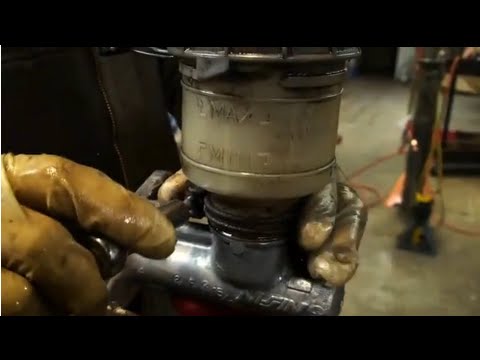
So my brother tells me his car is not stopping and the brake pedal is slowly sinking to the floor when he is at a stop light, my solution, a master cylinder …
So my brother tells me his car is not stopping and the brake pedal is slowly sinking to the floor when he is at a stop light, my solution, a master cylinder …
You must be logged in to post a comment.
)
Hi Eric, So i have a 1998 Honda Accord coupe v6 and i changed my brake pads
a coupe months ago and now the brakes are hard to push on. But once the car
is warmed up, the brakes are normal again. What could be the problem to
this? the master Cylinder?
lol man , Rob needs a HaIrCuT .
Hay I have a 89 camaro I did these steps and my break is still going all
the way down and my cat won’t even stop anymore I had to use the e break
and almost got in an accident ……. please there’s gota be something else
… Help
For any Folks that are wondering- YES- brake fluid makes an EXCELLENT paint
stripper. It does take a while- but it is usually very thourough, right
down to bare metal- sometimes in a few hours or overnight.
Need help have to pump my clutch in order to go to first gear and cant
shift to any other gears. Can you make a video of this please using same
car if you can have a 91 Integra looks like the same car in your vid.
Thanks
He doesn’t respond to peoples’ comments.
You sir are a big help thanks to you i changed out my distributor in my
acura and now i’ll fix my the master cylinder on my 4runner thanks
7:50 totally felt that was going to happen XD
yup
I aughed when you said remove anything thats in the way (1969 Car Owner)
A very informative video Eric, thanks. But I noticed you didn’t use Honda
brake fluid and you didn’t mention adjusting the pushrod as in the service
manual. Is the adjustment and Honda brake fluid not really necessary?
My car makes a hissing noise when I apply the pedal, and it stops, but very
badly. Would it be the master cylinder or the brake booster?
I have an 02 Kia Sportage and on some forums there is talk of a special
tool needed to bench bleed. I noticed in the video you brought this up too.
If I have a helper and a vice my guess is I have all I need, is this true?
just wondering what would cause a 1995 nissan pathfinder to not put full
braking power to all the wheel when you have the pedal as far down as it
would go. so would this be caused by a bad master cylinder or a lot of air
in the lines.
40 mins and up for a rookie. 25 mins or less for ppl that know what they’re
doing
Great video. I just learned something here.
good vid and thanks
Nice vid!
Yo Eric(the car guy) How are you? What do I do with a 3.5 dodge charger
that has low compression in two cilinders? Engine shaking, disaster
waiting, pain and suffering… Thanx
very helpful eric. my mechanic told me i need a new proportioning valve and
master cylinder but it looks like i just need a master cylinder…now i
just need to replace a brake line and im done
Eric how did you know this wasnt a leaking brake booster? I have the same
situation in my ford F250 right now and I am trying to figure out if it is
leaking booster or master cylinder. I can hear a hissing noise as the pedal
sinks, probably booster vacuum?
Thanks Eric. A well planned video with sepreme help.
Eric can one use the same procedure to bleed a clutch master cylinder?
Thanks Gene
master cylinder = spongy or brake pedal that goes to the floor or that goes
slowly to the floor when you press on it with engine on. brake booster =
very hard brake pedal , brake booster is basically a simple device to
lessen your brake pedal effort.
Great video, very helpful! Thanks!
I like your video’s, Its quite helpfull when your not a gearhead! Also, you
bring some humor into it. Makes it amusing to watch and learn =)
Thanks for the great info. I am helping a friend do this today and this was
the first and only one I needed to watch.
How do you know that it is the master cylinder that is bad VS the booster?
On that note people if you have a low or spongy brake pedal it can be air
in the system or worn pads, keep it simple check your fluid resovoir if its
low it can mean that you have worn brake pads. A braking system is a sealed
sysem and in optimal conditon should not leak so check you break pads to
see if their worn, your reservoir acts as a guage that should’nt be opened
and will get low if you break pads or lining is worn if thats not the case
then go with Erics video.
You saved me $200 thank you
good videos. I just changed front wheel brake hoses, and forgot about the
fluid level and got air in master cylinder .. 🙁 more work for me 🙂
I’m sorry, but it wouldn’t be right if I didn’t say it….your concerned
customer has an awesome skullet.
Great video, thanks
appreciate ya! very informative and easy to watch. stay dirty!!!
THanks man!
Lack of vacuum to the booster is a good start. I’ve gone through everything
in an old vw diesel. The system is a bit more basic and the brake system
has a dedicated pump to supply air to the booster. If that fails or if
something is wrong with the booster, brakes are pretty much manual and hard
to push. But boosters are typically rare to fail so it’s usually a lack of
vacuum.
Is there a way to tell certainly that u need to replace the BMC?
Great video, thanks.
that is an internal leak in the master cylinder.
what kind of master cylinder was that? i know that wasnt a step bore. thanks
Why did he have to pump 3 times and them hold while you were loosening the
master cylinder hoses
great video – thanks for posting