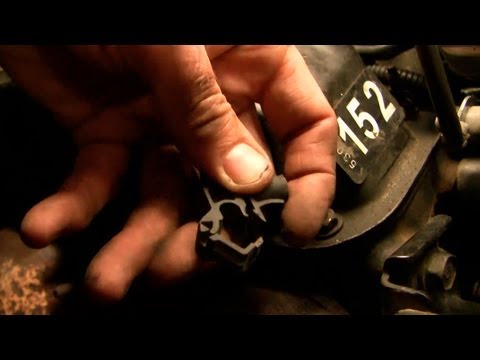
A short demonstration of how I replaced a set of leaking rocker cover gaskets in a 1998 Dodge Ram 5.9L 4X4. Never rely on one source of information before ma…
A short demonstration of how I replaced a set of leaking rocker cover gaskets in a 1998 Dodge Ram 5.9L 4X4. Never rely on one source of information before ma…
You must be logged in to post a comment.
)
Glad I watched this before installing my new gaskets.Been awhile since I
wrenched and the simple things as cleaning out the intake valley area along
with removing the wire holders saved me some time and aggravation.
Yeah, it sounds like you had the same experience I did. Thanks for taking
the time to record your findings here!
I recently did my valve cover gaskets on my Dodge Ram Van (5.2L). Aside
from some of the plastic wire holders and other small plastic pieces
cracking and breaking due them being so brittle, I didn’t have any issues
doing this job. Nice video.
If you could do that it would be great .. Thanks !! Saves me a ton of time
.
I can send you a pdf of where the wires go for the Magnum 5.9 if you can’t
find it. Thanks for watching and offering feedback on my videos. Dave
Your so right about the plug wires on chrysler/Dodge Magnum V8 engines ..
There is a TSB they put out about this .. I have to replace my wires and so
I will look it up .. Thanks !!
Yeah, it’s a way to pay it forward, as a form of thanks to those who have
helped me out. You get to meet a great bunch of people along the way.
If you put a little dielectric grease on the spark plug body’s before you
put the plug wires back on they well come off with little effort next time.
The grease also stops moisture from entering the boot.You can use it your
taillight bulbs also.
I agree, LTFT and STFT are so close to normal that I wouldn’t
over-interpret the numbers. As far as I can see, temp and thermostat are
OK. On returning home, I drive up a hill to get to my house, then shut the
engine off. Then on restart, most engines run rich for a bit until they go
to closed loop. When they enter closed loop, isn’t it natural for the PCM
to start taking away fuel?
it looks like you have no vacuum leaks (however i would check the map
sensor hose,it looked like like cracked when you removed it form the
throttle body. there are like cracks or things written on it ( ? )
Nice work Dave! Engine does look pretty clean.
I would check input first seen outputs seems normal i mean no codes or
crazy fuel trims, sounds like the pcm think he is in normal conditions He
is maybe fooled by inputs the sensors.
Thank you.
Thank you. I try to make a video that I would have wanted to see before
doing the job on this vehicle. Usually it’s the plastic clips and the blind
fasteners that waste most of my time.
Dave, great job, love the shop vac attachment great idea
The PCV side was much worse in my truck. There was a ton of sludge compared
to yours though.
Good video man
Lately it’s been running fine, better with the new O2 sensor. Thanks for
visiting, Harry.
Does it smell gas at the pipe ? like scannerdanner said in a vid
downstream sensors are just to check catalyst job upstream ones are working
you tested them,even if a bit slow you just would have lag to the afr
correction but not a 5 MPG difference i think. Something make your ecu
think he have to use more fuel. it’s a mechanical problem,like a big drag
or pissing injectors or a fuel management problem, more fuel means more air
or air density causing enrichment for cold conditions.
Dodge going to run like new when your finish with it.
Well done. what did you decide regarding your low idle miss ? I still have
not had the time to address mine.
Those replacement gaskets look very puffed up, i get the impression they
will seal very well 🙂 The droopy drive tool is apparently due to my age
according to my doctor lol, no sorry, that droopy looking uj looks handy
🙂 Sorry im in a daft mood 🙂
As I showed in the video I put it inside the boot. Of course the two
surfaces make direct contact, and I rotate the boot on the plug, so which
of the two surfaces to put it on doesn’t really matter. As you point out,
the goal is to form a consistent barrier to water and oxidation. Many
people have the misconception that dielectric grease promotes conduction,
and of course the opposite is true. Thank you for watching.
Sorry: Somehow i miss you using the grease.
Great job cleaning up the rocker covers. They looked great when ready to
reinstall. If you want to know how to do something and there isn’t a video
for it then make one. That’s kind of how I got started with the lack of
info out there on my vehicle. Now there’s a video on how to replace the
valve cover gasket for a 98 Dodge Ram. 🙂
Thanks, Will. I appreciate you putting in the time to watch.
Does the engine reaches its normal running temperature ? Are you sure the
thermostat is working properly ? Is the coolant temperature sensor ok too ?
-1.5% LTFT is nothing but maybe if the engine is always too cold or if the
coolant sensor is kaput the ecu still thinkng it’s in cold conditions. LTFT
is significant if the ecu thinks HE HAVE TO remove fuel. You complain about
a crappy fuel mileage : that mean you use more fuel than before.
No worries! I’m happy to see people like yourself, those with experience
stopping by.
Yeah, I was happy to see that. I change oil and filter religiously every
5000 km, always natural oil. You notice there was some baked-on carbon on
the undersurface of each cover. Interestingly, carbon-baking was much worse
on the PCV side. I guess you would expect that, given that cool clean air
enters the breather side, flushing hot gas and impurities over to the PCV
side. Thanks for watching, Steve.
I was planning on doing the plenum and then the upstream O2 sensor, but now
that the plenum is on hold I went ahead and did the O2 sensor yesterday.
Video of diagnostics done, just rendering it now. In the coming weeks I’m
going to make a little smoke machine and look for a vac leak, and I may
replace the PCV valve. But at this point it’s going to be a step by step
process since I want to quantify whether some of these things helped. Thank
you for watching!
For the first time in my life, it’s appropriate to type ‘lol’ (grin).
🙂 great work !
WOW , no sludge at all. Do you use synthetic oil.