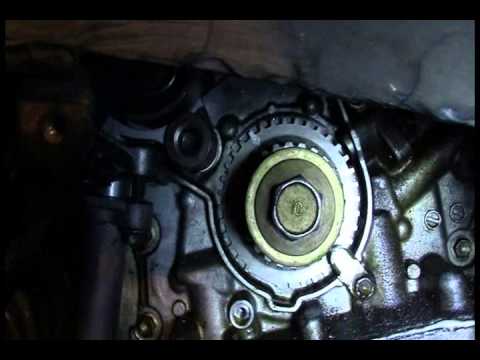
Final part in the series on replacing a timing belt on a Toyota Sienna V6 3.0L. Part 1 can be found here: http://www.youtube.com/watch?v=VO0UxIUAHJw.
Final part in the series on replacing a timing belt on a Toyota Sienna V6 3.0L. Part 1 can be found here: http://www.youtube.com/watch?v=VO0UxIUAHJw.
You must be logged in to post a comment.
)
Matt, your wife is a a lucky woman. I could just listen to scientific-based
mechanics for hours. *sigh* FYI, I am a female. I love how you put put a
lot of thought into explaining the details like the interference engine
movement and the rest of the mechanics interlaced with tidbits of sound
scientific reasoning. On a professional level, thank you for providing this
instructional video so that I may carry out these steps when working on my
vehicle.
excellent video, couldn’t have ask for better, very thorough, thank you for
sharing, now all my question about timing were answered, my brother just
had his timing belt done at the dealer, if I saw this video earlier I think
my brother could have done the job himself the correct way, now my brother
is not happy with the dealer timing belt job because his car is not like
before, idles a little rougher, before de engine was so quiet when its
idling. Any suggestion as to why it idles rought. Again thanks for
sharing.
Timing Belt (TIMING): Good job on the timing of the timing belt. I give
you an 8 on a scale of 1-10. This procedure is extremely important because
if you do not get it correct you will need to do the job over. A lot
mechanics and want to be mechanics will get this process wrong and have to
do the job over. Timing is the main essence of this procedure, hence
timing belt change and yes changing the belt is important, getting the
timing correct is just as important. I have seen ASE profession mechanics
do timing belt YouTube videos on the 1MZ-FE and yes they complete the job
but they do a poor job of explaining the process to a level of the DIY er.
Great video series! I did not quite understand how you could take the belt
off the rear sprocket with the jammed wrench there. It seemed to block the
belt from coming off. Is the wrench there more of an insurance against the
sprocket accidentally being moved?
Rear Cam Sprocket: Why did you lock the rear cam? You kept mentioning the
possibility of jamming the valves. Need I remind you, the 1MZ-FE is a non
interference engine.
Matt! I am waiting for some new videos, I am quite bored this week jeje
Great series, Matt. Reading through the comments so far, you’ve assembled a
group of bright and thoughtful viewers. Meeting guys like this is a big
part of the reward for following along (grin).
Hi, I couln’t really imagine a slipping belt over one of the idler pulleys
or tensioner.. I once experienced a frozen idler pulley while driving on
the highway and the belt immediately failed.. the teeth were stripped off
of almost half of it!! Unfortunately that was an interference engine as
well so I ended up replacing it. Did the belt service on the replacement
unit including the pulleys etc.. and it ran for years aftwerwards..
Fantastic job Matt – I got a lot of good tips from this series. Thanks for
doing this.
Did you add sealant to the new water pump gasket? Doesn’t look like any
was on the old one. Awesome series!
One more question if you have time:
When you raise the engine a bit to clear the sidewall for water pump
removal, I’m guessing you must first loosen the other engine mounts? Or,
will the engine move with a jack from below without loosening the other
mounts?
Your title is misleading or you just don’t know what you are talking about.
My generation of sienna which is 2008 sienna uses Timing chain and not a
belt. I’m aware that the generation prior to my generation of sienna uses
Timing Belt. You better correct your tittle. My 2008 sienna is under the
2nd generation which uses timing chain and not a timing belt. 2nd
generation are 2004 – 2010 Sienna. I hope you’ll correct you tittle.
okay…
Why waste the nice V6 engine on such a horrible car. They should have used
3L inline 4 with balance shafts. That’s all such vehicles deserve.
Instead of saying something like “thanks for the helpful hints” you make
some snide remarks instead of trying top understand where someone is coming
from. Well, it’s understandable coming from someone who makes fun of people
in your videos. As opposed to say someone more likeable like ScannerDanner.
Where do you get the torque specs from ? Is there a website that you would
recommend ! I’m a DIY I learn from your videos this is amazing how you guys
can teach as if we were in class. Thanks!
Hi, I was wondering on this or any interference engine when you backed off
the crank 2 or 3 teeth I would of bricked it thinking I’d make valve
contact because one revolution equates to 2 of the cams obviously not the
case though. When I first attempted TBelt change on my 1.9jtd 8v recently I
did back up the cam a bit tension side to accept belt mark and all was fine
after tension. So generally have you sufficient clearance to aid belt
install, cheers great videos again!
Thanks very much for this!
I have a question regarding the rear cam:
I see that you needed to remove the wrench in order to remove/replace the
belt, so I’m guessing that it takes a significant bump to cause the cam to
spring backward? Or, is it possible that at any moment it is not supported
by the wrench for it to suddenly spring backward and one must rely on luck?
What if I decided to proceed as the book suggests, and rotate it back 40
degrees? Would I just rotate it back to the previous position when placing
the new belt? No special trick needed in that instance?
Thanks again for your time and information!
i usually also change the shaft seals of the cam crank and oil pump if oil
pump i cam sprocket driven, if the vehicle had its secound belt change and
no sign of the seals been replaced as they can oil up the new belt when
they fail ,
Also i always disconnect the battery , i know immobilizer car radio etc.
but the risk of somone starting a car i do a belt on while i have to dash
out from the shop is to big a risk and a spanner or something actuating the
starter while you have the belt off is another risk. a small risk but if
the battery is disconected this risk is eliminated also. one can use a
small batt to keep the system allive if it needs continues power ……
for sprokets often there is a lock tool and i do undo the cam bolts with
the impact gun befor i remove the cambelt just to crack them loose , but
the cam bolt and balancer is often the biggest problem
Im sure autozone, advance auto, and the other parts disturbers fear you.
LOL. Teaching Parts Changers to become knowledgeable Techs. Great Job. Did
you end up finding out what the vibration was on the VW, the car that you
proved the axles were not the cause of the issue, Im curious what ended up
being the issue? And Do you have any tricks on isolating a noisy pulley.
You know, when you have a noisy accessory, idle or tensioner pulley, but it
is hard to isolate exactly which one is bad. Sometimes Even when you try to
listen with a stethoscope, its hard to determine which damn pulley it is.
Hello Matt, liked your video only thing I saw that did not sound too good
to me is how your described a couple of things. I am not a mechanic but I
did take a course at a skills center back in the day so I know at least
what I am talking about. It lies where you describe air/fuel mixture as an
“explosion” and when you advise about reestablishing the belt tensioner
into the full retracted position if a mistake has occurred. An explosion is
actually a bad thing and can be a sign of carbon deposits and cause engine
pinging. You say, in order to retract the pin that a vise can be used to
“crush” the pin back in and I know what you meant and so do most people who
are watching but these things can get confusing to some people. One does
not want to “crush” anything at all here but just have it the pin
compressed back to its original position. Just wanted to make everyone
understand more fully the ideas you want to get across.
What type of sealant do you use to put the water pump, thermostats…
Nice work Matt. Lots of good tips that I’m sure others will get a lot of
benefit from this video series. Thanks for posting.
Exelent video!
Hey man…I just finished watching all 3.. very excellent 3 part series on
timing belt replacement. You did an excellent job and covered A TON of
info that will be helpful for anyone tackling this job wether its on this
exact vehicle or any other! I liked seeing your tip about using clamps to
hold the belt to the cam pulleys…I use zap straps personally but the effect
and outcome are the same 🙂 On some engines, that little trick alone is
worth its weight in gold! 🙂 This series will be a big hit on your channel
I am sure!
If removing cam sprockets, please pull the alignment pins (if used) to
inspect them for being slightly sheared, the same as the crank alignment
key, along with the cam gear alignment hole or slot for being elongated.
Any problem here will effect timing as well. The alignment pins can be
completely sheared and on your initial belt alignment inspection and
re-alignment for what seems to have jumped a tooth or two will actually be
a sheared alignment pin so please BEWARE. The torque of the cam gear bolt
will make it seem as though everything is good as the gear will not float
by hand but once the bolt torque is broken, the gear will spin freely.
This is yet another reason why I disassemble the cam gear is to do a full
inspection of the related items. Be sure to mark the gears I & E, I have
seen them put back on the wrong cam and put on flipped over, some gears
have what appears to be multiple types of alignment marks so BEWARE once
again. I like to put the crank pulley on temperarily to keep the new belt
from falling off, start the engine, rev it a little to check for power
availability (may be off by a tooth for some reason) and verify if any of
the new bearings may be bad, for what its worth, then reassemble the entire
job. Scan tool readings may show something if you have one to show a
timing issue, or use a simple vacuum gauge.
Timing Belt Covers: Why did you not show the appearance of the inside of
the covers? Quite often the determination as to whether to change out the
3 seals will be determined by this inspection. Some will automatically
change the seals but some mechanics will inspect the covers and if they see
oil will change the seals and others will not change the seals if there is
no oil.
you did not change the camshaft and crankshaft seals?
I really liked the video series. Thank you.
I learned a lots from you.Thank you.
Thanks for your response!
Thank you very much!